
Textured Surfaces for Safer Walking Routes on Site
A walking route on site is only as safe as the surface underfoot, and a smooth film panel becomes hazardous the moment it gets wet. Dongstar Wood's wire mesh range carries a textured hexagonal phenolic film for grip; sheets start at 1220 × 2440 mm, custom panels reach 1830 × 3830 mm, and thicknesses span 9 mm to 21 mm.

Key takeaways
- The grip face is a phenolic film with a hexagonal wire-mesh emboss, and the range covers single-sided and double-sided panels.
- Sizes run 1220 × 2440 mm, 1250 × 2500 mm and 1500 × 3000 mm in the standard range, and custom orders extend up to 1830 × 3830 mm.
- Thickness spans 9 mm to 21 mm for different load requirements.
- Adhesives include WBP phenolic, melamine and E1/E0, with sealed edges for site duty.
The hazard being managed
Scaffolding boards, roofing walkboards and temporary floors all fail the same way: a smooth surface, a little rain, and a boot that was planted a half-second too late. The textured film exists for that half-second. A hexagonal wire-mesh pattern gives the boot something to bite into when the surface is wet, dusty or muddy, which is the condition most site walkways are actually in.
The page names its applications in plain language: safe access platforms, temporary flooring, roofing walkboards, slip-resistant scaffolding boards, bridge deck construction and industrial concrete slab formwork. Every one of them is a walking or standing surface where a slip has consequences. High-rise shuttering and industrial concrete slab formwork are named alongside the walkways, because the same panel that is safe to walk on is safe to pour against.
How the textured surface works
The film is a phenolic sheet embossed with a hexagonal wire-mesh pattern, bonded to the panel under the same high-pressure hot pressing as the smooth films. The texture is not a coating applied afterwards — it is part of the film, so it wears at the same rate as the surface beneath it rather than flaking off.
The range is available single-sided, with a smooth reverse, or double-sided. Single-sided suits walkways where one face is walked and the other is fixed to the frame; double-sided suits panels that are turned over in use, which doubles the working life of the board. The wire-mesh name comes from the pattern's resemblance to woven mesh, and the hexagonal geometry gives grip in every direction rather than along one axis, which is what a boot needs when the approach angle changes.
Sizes and thickness for the load
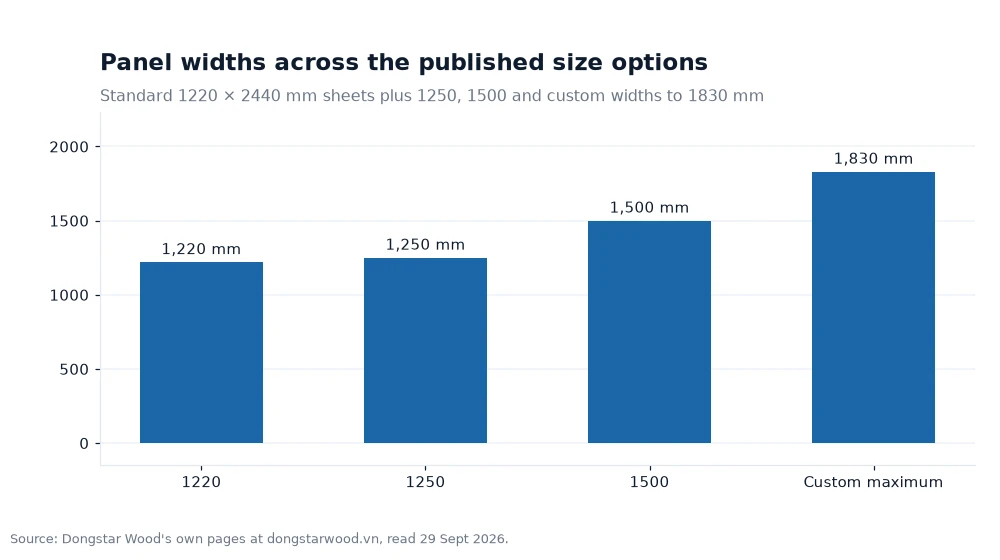
The anti-slip range ships in three standard widths — 1220 × 2440 mm, 1250 × 2500 mm and 1500 × 3000 mm — and custom orders can go up to 1830 × 3830 mm. A standard sheet measures 1.22 × 2.44 = 2.9768 m², which is the figure to use when a walkway area is being divided into panel counts.
Thickness runs from 9 mm to 21 mm for different load requirements. A light access platform sits at the thin end; a bridge deck or a heavy-duty formwork panel sits at the thick end. The thickness is chosen for the span and the load, not for the slip resistance, which is a property of the film. The custom maximum of 1830 mm covers the wide walkways that standard sheets cannot span without a joint, and a joint in a walkway is a trip hazard in its own right.
Adhesives and edge protection
Adhesives on the range are WBP phenolic, melamine or E1/E0. For site duty the WBP phenolic system is the relevant one: it keeps the veneer layers bonded through the wetting and drying cycles a walkway panel goes through, season after season. Melamine and E1/E0 suit the drier interior applications.
Sealed edges are part of the specification, and they matter more on a textured board than on a smooth one. The texture gives water and mud somewhere to sit, and an unsealed edge lets that moisture into the core. A sealed edge is the difference between a board that survives ten site seasons and one that delaminates in two. A board that is stored wet and stacked flat will delaminate at the edges regardless of the glue class, so the storage rule is as much a part of the specification as the adhesive.
Reuse, maintenance and board life
Board life on this range is stated as a claim of multiple reuse cycles, conditional on proper edge and surface maintenance — the honest way to put it, because the cycles are earned, not given. A board that is stacked dry, carried on edge and stored out of the sun will outlast one that is left in a puddle, and the textured film rewards that care by keeping its grip.
Wear resistance, moisture and wear resistance, and alkaline concrete exposure protection are the published performance claims. The alkaline protection is the one that matters on formwork: fresh concrete is alkaline, and a film that breaks down in alkaline conditions loses its texture — and its grip — exactly where it is needed. The surface should be cleaned of concrete build-up between cycles, because a film clogged with cement loses its texture long before it loses its strength.
| Site surface | Published option | What it provides |
|---|---|---|
| Scaffolding boards | Textured film, 9–21 mm | Grip underfoot at height |
| Roofing walkboards | Single or double-sided | Safe access on slopes |
| Temporary flooring | Sealed edges, WBP glue | Wet-site durability |
| Access platforms | Hexagonal texture | Slip resistance when wet |
Worked example: a walkway from sheet area
Area arithmetic sizes a walkway before the panels are ordered. A temporary access route 20 m long and 1.2 m wide is 20 × 1.2 = 24 m². One standard 1220 × 2440 mm sheet covers 2.9768 m², so the walkway needs 24 ÷ 2.9768 = 8.06 sheets — nine boards, with the ninth cut to fit the end of the run.
Double-sided panels change the arithmetic over the life of the walkway. A board turned once delivers two working faces, so the same 24 m² route can be re-surfaced without new material. The thickness is then chosen for the span between supports, not for the area.
Frequently asked questions
What gives the anti-slip panel its grip?
A textured hexagonal wire-mesh phenolic film, bonded to the panel under high-pressure hot pressing. The texture is part of the film itself, so it wears at the same rate as the surface rather than flaking off.
Can the panels be used on both sides?
Yes. The range is available single-sided with a smooth reverse, or double-sided for panels that are turned over in use, which doubles the working life of the board.
Which adhesive suits outdoor site duty?
WBP phenolic is the relevant system for site duty, because it keeps the veneer layers bonded through repeated wetting and drying. Sealed edges complete the specification by stopping moisture entering the core.
Specifying the surface that keeps people upright
A safe walking route is a specification, not a hope. Check the Anti-slip Film Faced plywood page for the current size, thickness and adhesive options, then read the company profile for the factory figures behind them. Where the same project also needs smooth-faced formwork on a tight budget, the ordinary black range covers the economical end. The sites with fewest incidents are the ones where the surface was chosen on purpose.
Figures cited here come from Dongstar Wood's product listings as read on 29 Sept 2026[1].